

What the body does with a dose of stress.
The principle behind EXALTxp is old and well understood: give the body a controlled dose of something hard, let it recover, and it adapts. Here is what each environment does, what we measured, and what we do not claim.
Less oxygen in the air.
At sea level, air is 20.9% oxygen. An EXALTxp studio lowers that to between about 11% and 17% by adding nitrogen, while the air pressure stays normal. The body responds the way it does in the mountains: breathing and heart rate rise for a given effort, and over repeated sessions the body becomes more efficient at delivering and using oxygen.
How cells sense and respond to oxygen levels was the subject of the 2019 Nobel Prize in Physiology or Medicine. Training in low oxygen is used by endurance athletes, mountaineers and professional teams to prepare for altitude and to build aerobic capacity.
The Nobel reference describes the underlying biology. It is not an endorsement of EXALTxp.
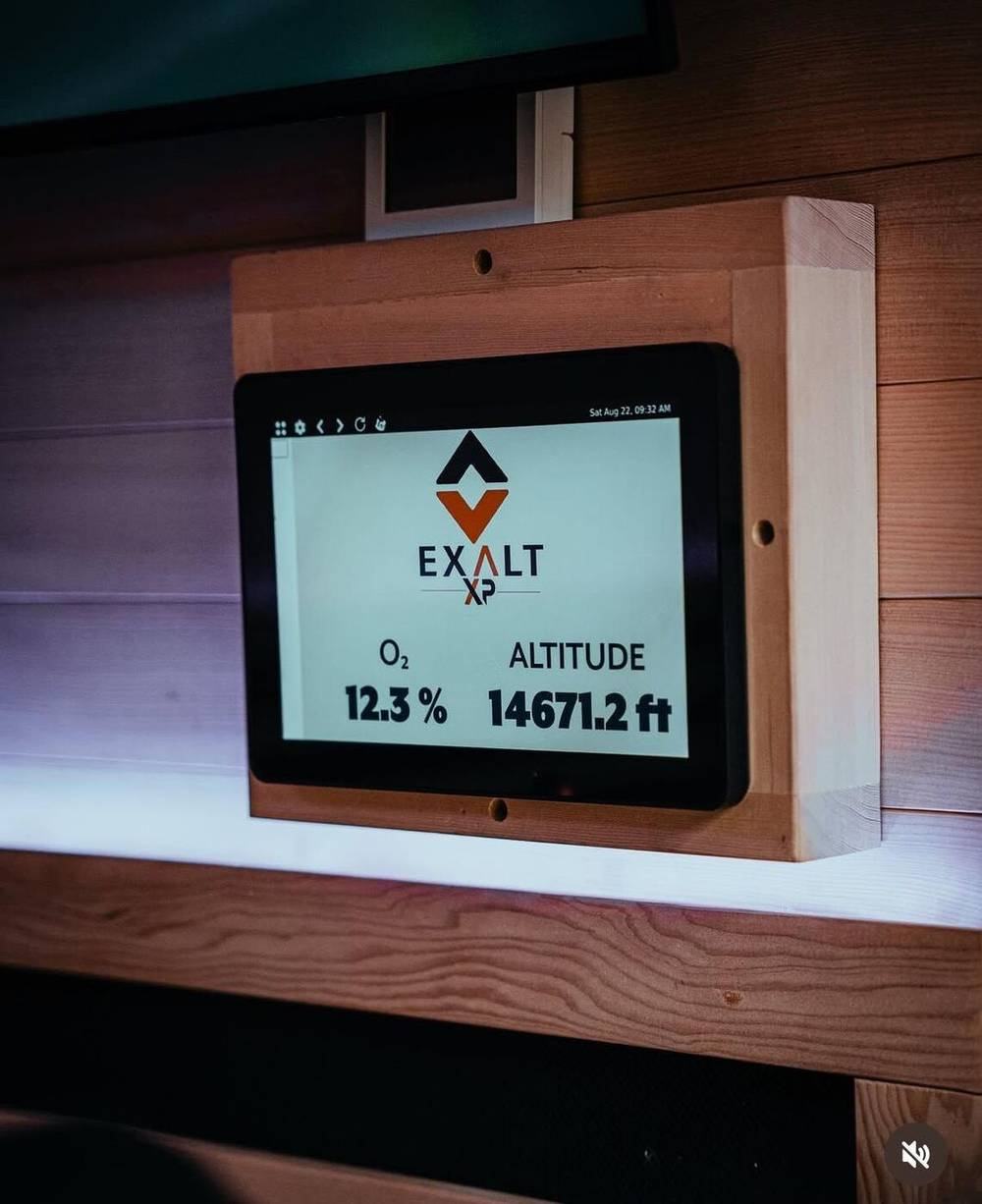
The studio screen: oxygen and the altitude it is equivalent to, shown live.
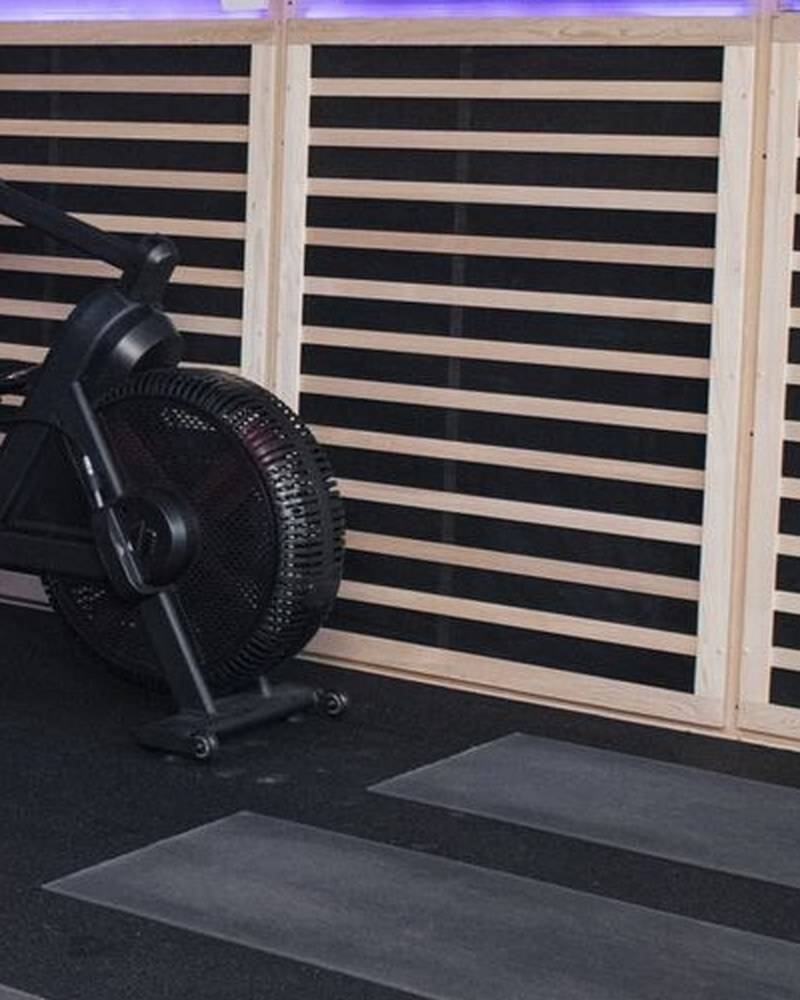
Training warm.
Carbon infrared panels warm the room up to 45°C. Repeated training in heat is a long established way to build heat tolerance: the body learns to sweat earlier, hold a lower heart rate at the same effort, and cope better with hot conditions. It is used by athletes preparing for hot climates and by people who want to train their conditioning in less time.
Altitude sessions and heat sessions are run on separate days in the programme, so each dose is clear.
Light for recovery.
Red and near infrared light panels are built into the walls and used in the recovery part of a session. Red light is widely used by professional teams and recovery clinics. The research is broad and the results depend on dose, so we describe it as a recovery environment and make no medical claim for it.
Red light was not part of the measured dose in the Genesis pilot.
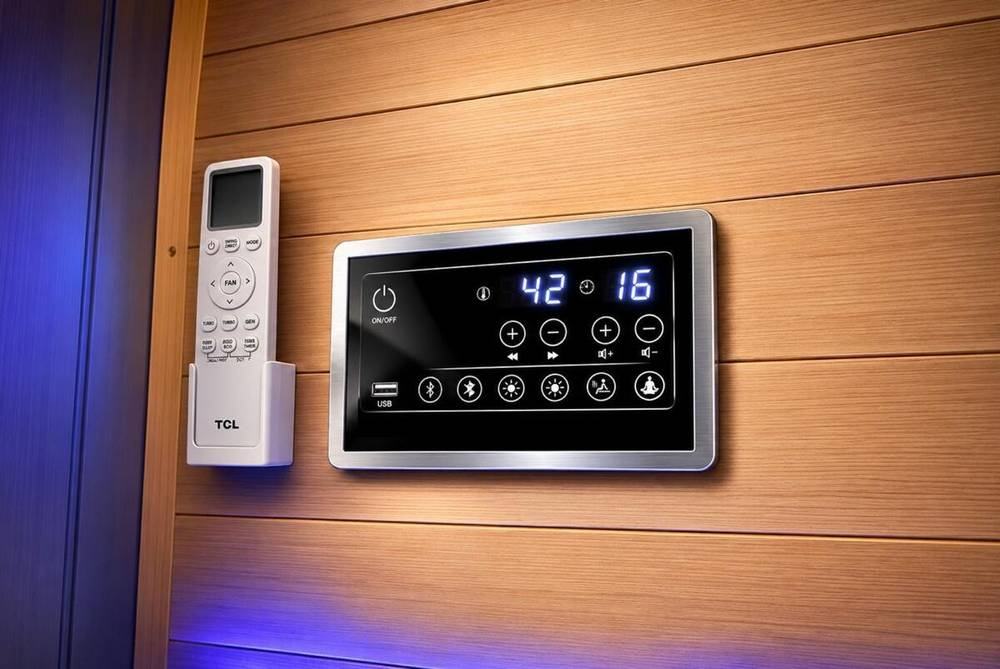
Each one is a shortcut. Together they compound.
A sauna, an altitude room and a light bed are three machines, three bookings and three bills. Put the three in one room, in the right order, and each one makes the next one work harder.
Less load. The same work for the heart and lungs.
With less oxygen in the air, the same effort asks more of the engine, so the body can ease the mechanical load and still get the training effect. Roman's rule of thumb: every 3,000 ft takes about 6% off the load.
Faster into the hard zone, and longer in it.
Heart rate climbs with core temperature. Leo's comparison: four hard intervals at room temperature might give six minutes in the 90% to 100% zone. A 20 minute heat session can hold you there for most of it.
Recovery in the same hour.
Red and near infrared light is built into the walls, so the session closes with recovery instead of a drive to another appointment.
Sixteen sessions, one hour each.
Run in sequence across a week, altitude on two days and heat on two, the room did in four weeks what the Genesis members reported: 14 of 15 improved aerobic capacity, 17 of 17 heat tolerance, 15 of 17 flexibility. Altitude and heat did that work; red light was not part of the measured dose. One room, one timetable, one coach.
Why no one else has it.
Altitude rooms exist. Saunas with red light exist. EXALTxp puts all three in one sealed, flat packed room, with a method to run them together. The science.
The Genesis pilot, exactly as the report states it.
20 members at Genesis Health + Fitness, Cooks Hill, NSW, trained for four weeks from 6 to 31 July 2026. 17 completed the programme and 15 took paired aerobic tests.
| Measure | Improvement | Before to after (average) | Improved |
|---|---|---|---|
| Aerobic capacity (VO₂ max, estimated) | +22% average, +13% median | 40.1 to 48.9 ml/kg/min | 14 of 15 |
| Flexibility (sit and reach) | +41% | 8.2 to 11.6 cm | 15 of 17 |
| Self rated performance* | +37% | 23.7 to 32.5 of 40 | 16 of 17 |
| Energy* | +32% | 15.1 to 19.9 of 25 | 14 of 17 |
| Heat tolerance* | +30% | 13.5 to 17.5 of 20 | 17 of 17 |
| Sleep* | +28% | 15.8 to 20.2 of 25 | 12 of 17 |
| Total wellbeing* | +26% | 139 to 176 of 215 | 16 of 17 |
| Stress regulation* | +26% | 16.4 to 20.5 of 25 | 13 of 17 |
* Self reported, scored by each member before and after. Genesis pilot, Cooks Hill, NSW, 6 to 31 July 2026: 20 members, 17 completed the four weeks, 15 took paired aerobic tests. Improvement is the change in the group average. Altitude and infrared heat sessions; red light was not part of the measured dose. A single group with no control group. Body composition and pain did not change. The results show what members experienced, not proof of cause or a guarantee of any result.
The median aerobic gain was 13%. Peak power rose on average but did not hold up under the strict test, so it is not reported as a result. A controlled comparison is the next step.
Wellness and performance. Not medicine.
No medical claims
EXALTxp studios are general wellness and performance products. They are not intended to diagnose, treat, cure or prevent any disease, and we do not say they extend life.
No guarantees
The pilot shows what one group of members experienced over four weeks. It had no control group, so it does not prove cause, and individual results vary.
No novelty claims
Altitude rooms, infrared heat and red light each exist on their own. What EXALTxp does is put the three in one modular room with a coached method.
The science
What altitude, heat and red light do to the body, and what the evidence shows.
Read moreGo deeperSafety
Screening, oxygen monitoring, who should check first, and our wellness position.
Read moreGo deeperSpecifications
Sizes, power, ventilation, site needs and what installation includes.
Read moreGo deeperOwning a studio
Prices, payment stages, lead times, warranty and the path to your first session.
Read more